AI Coding Tools

Explore the best AI Coding Tools — independent reviews, comparisons, pricing and step-by-step how-to guides, curated by Aizhi.

  • Spell checker

    Spell checker

    In software, a spell checker (or spelling checker or spell check) is a software feature that checks for misspellings in a text. Spell-checking features are often embedded in software or services, such as a word processor, email client, electronic dictionary, or search engine. == Design == A basic spell checker carries out the following processes: It scans the text and extracts the words contained in it. It then compares each word with a known list of correctly spelled words (i.e. a dictionary). This might contain just a list of words, or it might also contain additional information, such as hyphenation points or lexical and grammatical attributes. An additional step is a language-dependent algorithm for handling morphology. Even for a lightly inflected language like English, the spell checker will need to consider different forms of the same word, such as plurals, verbal forms, contractions, and possessives. For many other languages, such as those featuring agglutination and more complex declension and conjugation, this part of the process is more complicated. It is unclear whether morphological analysis—allowing for many forms of a word depending on its grammatical role—provides a significant benefit for English, though its benefits for highly synthetic languages such as German, Hungarian, or Turkish are clear. As an adjunct to these components, the program's user interface allows users to approve or reject replacements and modify the program's operation. Spell checkers can use approximate string matching algorithms such as Levenshtein distance to find correct spellings of misspelled words. An alternative type of spell checker uses solely statistical information, such as n-grams, to recognize errors instead of correctly-spelled words. This approach usually requires a lot of effort to obtain sufficient statistical information. Key advantages include needing less runtime storage and the ability to correct errors in words that are not included in a dictionary. In some cases, spell checkers use a fixed list of misspellings and suggestions for those misspellings; this less flexible approach is often used in paper-based correction methods, such as the see also entries of encyclopedias. Clustering algorithms have also been used for spell checking combined with phonetic information. == History == === Pre-PC === In 1961, Les Earnest, who headed the research on this budding technology, saw it necessary to include the first spell checker that accessed a list of 10,000 acceptable words. Ralph Gorin, a graduate student under Earnest at the time, created the first true spelling checker program written as an applications program (rather than research) for general English text: SPELL for the DEC PDP-10 at Stanford University's Artificial Intelligence Laboratory, in February 1971. Gorin wrote SPELL in assembly language, for faster action; he made the first spelling corrector by searching the word list for plausible correct spellings that differ by a single letter or adjacent letter transpositions and presenting them to the user. Gorin made SPELL publicly accessible, as was done with most SAIL (Stanford Artificial Intelligence Laboratory) programs, and it soon spread around the world via the new ARPAnet, about ten years before personal computers came into general use. SPELL, its algorithms and data structures inspired the Unix ispell program. The first spell checkers were widely available on mainframe computers in the late 1970s. A group of six linguists from Georgetown University developed the first spell-check system for the IBM corporation. Henry Kučera invented one for the VAX machines of Digital Equipment Corp in 1981. === Unix === The International Ispell program commonly used in Unix is based on R. E. Gorin's SPELL. It was converted to C by Pace Willisson at MIT. The GNU project has its spell checker GNU Aspell. Aspell's main improvement is that it can more accurately suggest correct alternatives for misspelled English words. Due to the inability of traditional spell checkers to check words in complex inflected languages, Hungarian László Németh developed Hunspell, a spell checker that supports agglutinative languages and complex compound words. Hunspell also uses Unicode in its dictionaries. Hunspell replaced the previous MySpell in OpenOffice.org in version 2.0.2. Enchant is another general spell checker, derived from AbiWord. Its goal is to combine programs supporting different languages such as Aspell, Hunspell, Nuspell, Hspell (Hebrew), Voikko (Finnish), Zemberek (Turkish) and AppleSpell under one interface. === PCs === The first spell checkers for personal computers appeared in 1980, such as "WordCheck" for Commodore systems which was released in late 1980 in time for advertisements to go to print in January 1981. Developers such as Maria Mariani and Random House rushed OEM packages or end-user products into the rapidly expanding software market. On the pre-Windows PCs, these spell checkers were standalone programs, many of which could be run in terminate-and-stay-resident mode from within word-processing packages on PCs with sufficient memory. However, the market for standalone packages was short-lived, as by the mid-1980s developers of popular word-processing packages like WordStar and WordPerfect had incorporated spell checkers in their packages, mostly licensed from the above companies, who quickly expanded support from just English to many European and eventually even Asian languages. However, this required increasing sophistication in the morphology routines of the software, particularly with regard to heavily-agglutinative languages like Hungarian and Finnish. Although the size of the word-processing market in a country like Iceland might not have justified the investment of implementing a spell checker, companies like WordPerfect nonetheless strove to localize their software for as many national markets as possible as part of their global marketing strategy. When Apple developed "a system-wide spelling checker" for Mac OS X so that "the operating system took over spelling fixes," it was a first: one "didn't have to maintain a separate spelling checker for each" program. Mac OS X's spellcheck coverage includes virtually all bundled and third party applications. Visual Tools' VT Speller, introduced in 1994, was "designed for developers of applications that support Windows." It came with a dictionary but had the ability to build and incorporate use of secondary dictionaries. === Browsers === Web browsers such as Firefox and Google Chrome offer spell checking support, using Hunspell. Prior to using Hunspell, Firefox and Chrome used MySpell and GNU Aspell, respectively. === Specialties === Some spell checkers have separate support for medical dictionaries to help prevent medical errors. == Functionality == The first spell checkers were "verifiers" instead of "correctors." They offered no suggestions for incorrectly spelled words. This was helpful for typos but it was not so helpful for logical or phonetic errors. The challenge the developers faced was the difficulty in offering useful suggestions for misspelled words. This requires reducing words to a skeletal form and applying pattern-matching algorithms. It might seem logical that where spell-checking dictionaries are concerned, "the bigger, the better," so that correct words are not marked as incorrect. In practice, however, an optimal size for English appears to be around 90,000 entries. If there are more than this, incorrectly spelled words may be skipped because they are mistaken for others. For example, a linguist might determine on the basis of corpus linguistics that the word baht is more frequently a misspelling of bath or bat than a reference to the Thai currency. Hence, it would typically be more useful if a few people who write about Thai currency were slightly inconvenienced than if the spelling errors of the many more people who discuss baths were overlooked. The first MS-DOS spell checkers were mostly used in proofing mode from within word processing packages. After preparing a document, a user scanned the text looking for misspellings. Later, however, batch processing was offered in such packages as Oracle's short-lived CoAuthor and allowed a user to view the results after a document was processed and correct only the words that were known to be wrong. When memory and processing power became abundant, spell checking was performed in the background in an interactive way, such as has been the case with the Sector Software produced Spellbound program released in 1987 and Microsoft Word since Word 95. Spell checkers became increasingly sophisticated; now capable of recognizing grammatical errors. However, even at their best, they rarely catch all the errors in a text (such as homophone errors) and will flag neologisms and foreign words as misspellings. Nonetheless, spell checkers can be considered as a type of foreign language writing aid that non-native language lea

    Read more →
  • Huawei Mobile Services

    Huawei Mobile Services

    Huawei Mobile Services (HMS) is a collection of proprietary services and high level application programming interfaces (APIs) developed by Huawei Technologies Co., Ltd. Its hub known as HMS Core serves as a toolkit for app development on Huawei devices. HMS is typically installed on Huawei devices on top of running HarmonyOS 4.x and earlier operating system on its earlier devices running the Android operating system with EMUI including devices already distributed with Google Mobile Services. Alongside, HMS Core Wear Engine for Android phones with lightweight based LiteOS wearable middleware app framework integration connectivity like notifications, status etc. HMS consists of seven key services and the HMS Core. The key services are Huawei ID, Huawei Cloud, AppGallery, Themes, Huawei Video, Browser, and Assistant. The web browser is based on Chromium. Huawei Quick Apps is the alternative to Google Instant Apps. By January 2020, over 50,000 apps had been integrated with HMS Core. Its rival, Google Mobile Services has 3 million apps on Google's Play Store. The AppGallery claimed 180 billion downloads in 2019. In March 2020, HMS was used by 650 million monthly active users across 170 countries. A Chinese phone manufacturer, LeTV, hosted a smartphone business communication meeting in Beijing on September 27, 2021, to demonstrate its phone, the LeTV S1. This was the first smartphone from a third-party manufacturer to include Huawei Mobile Services (HMS). == HMS on Android and HarmonyOS == Huawei Mobile Services on Android goes all the way back to August 2016 as Huawei ID services for phones, basic functionalities for Huawei P9 series. However, in May 2019 proved to be a significant change to HMS when Google was prohibited from working with Huawei on any new devices extending ecosystem for AppGallery store front launched in April 2018, year prior. This also included bundling Google's Apps, including Gmail, Maps and YouTube. Any new Huawei devices launched after 16 May 2019 were unable to receive updates from Google services and would be considered 'uncertified' meaning Huawei's only solution at the time was to turn HMS into a genuine competitor to Google and incentivize app developers to utilize the platform. Huawei officially launched Huawei Mobile Services in China on December 24, 2019, as a beta. Huawei expanded Huawei Mobile Services in Europe in February 2020 and other markets in Asia, Latin America, Middle East & Africa, Canada, Mexico followed outside banned US market. HMS is available on the Honor 9X Pro, View 30 Pro, Huawei Mate XS. HMS is also available, alongside GMS, on many other Huawei models launched before the ban. Huawei promised developers it would take, “less than 10 minutes", to port their app over to HMS - to illustrate the ease of portability between Google's Play Store and the HMS AppGallery. On January 15, 2020, HMS Core 4.0 (Huawei Mobile Services Core 4.0) was officially launched. Huawei announced that at this time, there were already 1.3 million developers and 55,000 applications on board. The next day, Huawei held a developer day event in London and invested £20 million to encourage developers in the United Kingdom and Ireland to use HMS. On July 15, 2021, Huawei expanded HMS with classic HarmonyOS dual-framework that provided Java support and eventually with JavaScript and ArkTS (eTS) language support with HMS Core 6.0 for app development with primarily Android apps, alongside limited HAP imperative developed based apps that shares AOSP file system libraries in all types of devices from smartphones, tablets, smart screens, smartwatches, and car machines. Including various third-party development frameworks, such as React Native, Cordova, etc. At HDC 2023, Huawei unveiled HarmonyOS 5, marking a total break from the hybrid Android derived platform. This shift replaced the legacy Android and classic HarmonyOS-based HMS SDK with a full native API developer kit SDK built solely on OpenHarmony. The architecture moved from middleware services to vertical integration path. In this new model, HMS Core libraries are no longer external add-ons but are bundled directly into the system and DevEco Studio as native HarmonyOS Kits. == HMS Core == HMS Core is a hub for Huawei Mobile Services and serves as a toolkit for app development on Huawei devices. The core comprises Development, Growth and Monetizing and was created as a replacement for Google Mobile Services (GMS) Core. HMS core services were available in more than 55,000 apps in June 2020; HMS Core 5.0 debuted in September 2020. HMS Core 6.0 was launched in June 2021 with extended support for Huawei Cloud services. In June 2021, the number of registered developers within the HMS ecosystem was 4 million, and the number of apps integrated with the HMS Core had reached 134,000. As of July 2022, registered developers within HMS ecosystem had grown to 5 million, and the number of apps integrated with the HMS Core reached 203,000. The number of apps had grown to 220,000 by 30 September 2022. == AppGallery == The AppGallery has a key rival, Google's Play Store on Android. The AppGallery is available in 170 countries, across 78 languages. == Reception == The reception of HMS is mixed, with the majority of discussion based around the key Google/Android apps which are not yet present on the AppGallery and whether or not this presents a significant problem to users. The open development of HMS Core has been regarded by some as benefiting the Android project as a whole, "If Huawei continues to invest in a holistically open approach ... the result could be that we could all end up a bit less beholden to Google".

    Read more →
  • INDECT

    INDECT

    INDECT is a research project in the area of intelligent security systems performed by several European universities since 2009 and funded by the European Union. The purpose of the project is to involve European scientists and researchers in the development of solutions to and tools for automatic threat detection through e.g. processing of CCTV camera data streams, standardization of video sequence quality for user applications, threat detection in computer networks as well as data and privacy protection. The area of research, applied methods, and techniques are described in the public deliverables which are available to the public on the project's website. Practically, all information related to the research is public. Only documents that comprise information related to financial data or information that could negatively influence the competitiveness and law enforcement capabilities of parties involved in the project are not published. This follows regulations and practices applied in EU research projects. == Application and target users == The main end-user of INDECT solutions are police forces and security services. The principle of operation of the project is detecting threats and identifying sources of threats, without monitoring and searching for particular citizens or groups of citizens. Then, the system operator (i.e. police officer) decides whether an intervention of services responsible for public security are required or not. Further investigation eventually leading to persons related to threats is performed, preserving the presumption of innocence, based on existing procedures already used by police services and prosecutors. As it can be found in the project deliverables, INDECT does not involve storage of personal data (such as names, addresses, identity document numbers, etc.). A similar, behavior-based surveillance program was SAMURAI (Suspicious and Abnormal behavior Monitoring Using a netwoRk of cAmeras & sensors for sItuation awareness enhancement). == Expected results == The main expected results of the INDECT project are: Trial of intelligent analysis of video and audio data for threat detection in urban environments Creation of tools and technology for privacy and data protection during storage and transmission of information using quantum cryptography and new methods of digital watermarking Performing computer-aided detection of threats and targeted crimes in Internet resources with privacy-protecting solutions Construction of a search engine for rapid semantic search based on watermarking of content related to child pornography and human organ trafficking Implementation of a distributed computer system that is capable of effective intelligent processing == Controversy == Some media and other sources accuse INDECT of privacy abuse, collecting personal data, and keeping information from the public. Consequently, these issues have been commented and discussed by some Members of the European Parliament. As seen in the project's documentation, INDECT does not involve mobile phone tracking or call interception. The rumors about testing INDECT during 2012 UEFA European Football Championship also turned out to be false. The mid-term review of the Seventh Framework Programme to the European Parliament strongly urges the European Commission to immediately make all documents available and to define a clear and strict mandate for the research goal, the application, and the end users of INDECT, and stresses a thorough investigation of the possible impact on fundamental rights. Nevertheless, according to Mr. Paweł Kowal, MEP, the project had the ethical review on 15 March 2011 in Brussels with the participation of ethics experts from Austria, France, Netherlands, Germany and Great Britain.

    Read more →
  • Albert One

    Albert One

    Albert One is an artificial intelligence chatbot created by Robby Garner and designed to mimic the way humans make conversations using a multi-faceted approach in natural language programming. == History == In both 1998 and 1999, Albert One won the Loebner Prize Contest, a competition between chatterbots. Some parts of Albert were deployed on the internet beginning in 1995, to gather information about what kinds of things people would say to a chatterbot. Another element of Albert One involved the building of a large database of human statements, and associated replies. This portion of the project was tested at the 1994-1997 Loebner Prize contests. Albert was the first of Robby Garner's multifaceted bots. The Albert One system was composed of several subsystems. Among those were a version of Eliza, the therapist, Elivs, another Eliza-like bot, and several other helper applications working together in a hierarchical arrangement. As a continuation of the stimulus-response library, various other database queries and assertions were tested to arrive at each of Albert's responses. Robby went on to develop networked examples of this kind of hierarchical "glue" at The Turing Hub.

    Read more →
  • Level-set method

    Level-set method

    The Level-set method (LSM) is a conceptual framework for using level sets as a tool for numerical analysis of surfaces and shapes. LSM can perform numerical computations involving curves and surfaces on a fixed Cartesian grid without having to parameterize these objects. LSM makes it easier to perform computations on shapes with sharp corners and shapes that change topology (such as by splitting in two or developing holes). These characteristics make LSM effective for modeling objects that vary in time, such as an airbag inflating or a drop of oil floating in water. == Overview == The figure on the right illustrates several ideas about LSM. In the upper left corner is a bounded region with a well-behaved boundary. Below it, the red surface is the graph of a level set function φ {\displaystyle \varphi } determining this shape, and the flat blue region represents the X-Y plane. The boundary of the shape is then the zero-level set of φ {\displaystyle \varphi } , while the shape itself is the set of points in the plane for which φ {\displaystyle \varphi } is positive (interior of the shape) or zero (at the boundary). In the top row, the shape's topology changes as it is split in two. It is challenging to describe this transformation numerically by parameterizing the boundary of the shape and following its evolution. An algorithm can be used to detect the moment the shape splits in two and then construct parameterizations for the two newly obtained curves. On the bottom row, however, the plane at which the level set function is sampled is translated upwards, on which the shape's change in topology is described. It is less challenging to work with a shape through its level-set function rather than with itself directly, in which a method would need to consider all the possible deformations the shape might undergo. Thus, in two dimensions, the level-set method amounts to representing a closed curve Γ {\displaystyle \Gamma } (such as the shape boundary in our example) using an auxiliary function φ {\displaystyle \varphi } , called the level-set function. The curve Γ {\displaystyle \Gamma } is represented as the zero-level set of φ {\displaystyle \varphi } by Γ = { ( x , y ) ∣ φ ( x , y ) = 0 } , {\displaystyle \Gamma =\{(x,y)\mid \varphi (x,y)=0\},} and the level-set method manipulates Γ {\displaystyle \Gamma } implicitly through the function φ {\displaystyle \varphi } . This function φ {\displaystyle \varphi } is assumed to take positive values inside the region delimited by the curve Γ {\displaystyle \Gamma } and negative values outside. == The level-set equation == If the curve Γ {\displaystyle \Gamma } moves in the normal direction with a speed v {\displaystyle v} , then by chain rule and implicit differentiation, it can be determined that the level-set function φ {\displaystyle \varphi } satisfies the level-set equation ∂ φ ∂ t = v | ∇ φ | . {\displaystyle {\frac {\partial \varphi }{\partial t}}=v|\nabla \varphi |.} Here, | ⋅ | {\displaystyle |\cdot |} is the Euclidean norm (denoted customarily by single bars in partial differential equations), and t {\displaystyle t} is time. This is a partial differential equation, in particular a Hamilton–Jacobi equation, and can be solved numerically, for example, by using finite differences on a Cartesian grid. However, the numerical solution of the level set equation may require advanced techniques. Simple finite difference methods fail quickly. Upwinding methods such as the Godunov method are considered better; however, the level set method does not guarantee preservation of the volume and shape of the set level in an advection field that maintains shape and size, for example, a uniform or rotational velocity field. Instead, the shape of the level set may become distorted, and the level set may disappear over a few time steps. Therefore, high-order finite difference schemes, such as high-order essentially non-oscillatory (ENO) schemes, are often required, and even then, the feasibility of long-term simulations is questionable. More advanced methods have been developed to overcome this; for example, combinations of the leveling method with tracking marker particles suggested by the velocity field. == Example == Consider a unit circle in R 2 {\textstyle \mathbb {R} ^{2}} , shrinking in on itself at a constant rate, i.e. each point on the boundary of the circle moves along its inwards pointing normally at some fixed speed. The circle will shrink and eventually collapse down to a point. If an initial distance field is constructed (i.e. a function whose value is the signed Euclidean distance to the boundary, positive interior, negative exterior) on the initial circle, the normalized gradient of this field will be the circle normal. If the field has a constant value subtracted from it in time, the zero level (which was the initial boundary) of the new fields will also be circular and will similarly collapse to a point. This is due to this being effectively the temporal integration of the Eikonal equation with a fixed front velocity. == Applications == In mathematical modeling of combustion, LSM is used to describe the instantaneous flame surface, known as the G equation. Level-set data structures have been developed to facilitate the use of the level-set method in computer applications. Computational fluid dynamics Trajectory planning Optimization Image processing Computational biophysics Discrete complex dynamics (visualization of the parameter plane and the dynamic plane) == History == The level-set method was developed in 1979 by Alain Dervieux, and subsequently popularized by Stanley Osher and James Sethian. It has since become popular in many disciplines, such as image processing, computer graphics, computational geometry, optimization, computational fluid dynamics, and computational biology.

    Read more →
  • Automatic acquisition of sense-tagged corpora

    Automatic acquisition of sense-tagged corpora

    The knowledge acquisition bottleneck is perhaps the major impediment to solving the word-sense disambiguation (WSD) problem. Unsupervised learning methods rely on knowledge about word senses, which is barely formulated in dictionaries and lexical databases. Supervised learning methods depend heavily on the existence of manually annotated examples for every word sense, a requisite that can so far be met only for a handful of words for testing purposes, as it is done in the Senseval exercises. == Existing methods == Therefore, one of the most promising trends in WSD research is using the largest corpus ever accessible, the World Wide Web, to acquire lexical information automatically. WSD has been traditionally understood as an intermediate language engineering technology which could improve applications such as information retrieval (IR). In this case, however, the reverse is also true: Web search engines implement simple and robust IR techniques that can be successfully used when mining the Web for information to be employed in WSD. The most direct way of using the Web (and other corpora) to enhance WSD performance is the automatic acquisition of sense-tagged corpora, the fundamental resource to feed supervised WSD algorithms. Although this is far from being commonplace in the WSD literature, a number of different and effective strategies to achieve this goal have already been proposed. Some of these strategies are: acquisition by direct Web searching (searches for monosemous synonyms, hypernyms, hyponyms, parsed gloss' words, etc.), Yarowsky algorithm (bootstrapping), acquisition via Web directories, and acquisition via cross-language meaning evidences. == Summary == === Optimistic results === The automatic extraction of examples to train supervised learning algorithms reviewed has been, by far, the best explored approach to mine the web for word-sense disambiguation. Some results are certainly encouraging: In some experiments, the quality of the Web data for WSD equals that of human-tagged examples. This is the case of the monosemous relatives plus bootstrapping with Semcor seeds technique and the examples taken from the ODP Web directories. In the first case, however, Semcor-size example seeds are necessary (and only available for English), and it has only been tested with a very limited set of nouns; in the second case, the coverage is quite limited, and it is not yet clear whether it can be grown without compromising the quality of the examples retrieved. It has been shown that a mainstream supervised learning technique trained exclusively with web data can obtain better results than all unsupervised WSD systems which participated at Senseval-2. Web examples made a significant contribution to the best Senseval-2 English all-words system. === Difficulties === There are, however, several open research issues related to the use of Web examples in WSD: High precision in the retrieved examples (i.e., correct sense assignments for the examples) does not necessarily lead to good supervised WSD results (i.e., the examples are possibly not useful for training). The most complete evaluation of Web examples for supervised WSD indicates that learning with Web data improves over unsupervised techniques, but the results are nevertheless far from those obtained with hand-tagged data, and do not even beat the most-frequent-sense baseline. Results are not always reproducible; the same or similar techniques may lead to different results in different experiments. Compare, for instance, Mihalcea (2002) with Agirre and Martínez (2004), or Agirre and Martínez (2000) with Mihalcea and Moldovan (1999). Results with Web data seem to be very sensitive to small differences in the learning algorithm, to when the corpus was extracted (search engines change continuously), and on small heuristic issues (e.g., differences in filters to discard part of the retrieved examples). Results are strongly dependent on bias (i.e., on the relative frequencies of examples per word sense). It is unclear whether this is simply a problem of Web data, or an intrinsic problem of supervised learning techniques, or just a problem of how WSD systems are evaluated (indeed, testing with rather small Senseval data may overemphasize sense distributions compared to sense distributions obtained from the full Web as corpus). In any case, Web data has an intrinsic bias, because queries to search engines directly constrain the context of the examples retrieved. There are approaches that alleviate this problem, such as using several different seeds/queries per sense or assigning senses to Web directories and then scanning directories for examples; but this problem is nevertheless far from being solved. Once a Web corpus of examples is built, it is not entirely clear whether its distribution is safe from a legal perspective. === Future === Besides automatic acquisition of examples from the Web, there are some other WSD experiments that have profited from the Web: The Web as a social network has been successfully used for cooperative annotation of a corpus (OMWE, Open Mind Word Expert project), which has already been used in three Senseval-3 tasks (English, Romanian and Multilingual). The Web has been used to enrich WordNet senses with domain information: topic signatures and Web directories, which have in turn been successfully used for WSD. Also, some research benefited from the semantic information that the Wikipedia maintains on its disambiguation pages. It is clear, however, that most research opportunities remain largely unexplored. For instance, little is known about how to use lexical information extracted from the Web in knowledge-based WSD systems; and it is also hard to find systems that use Web-mined parallel corpora for WSD, even though there are already efficient algorithms that use parallel corpora in WSD.

    Read more →
  • Elastix (image registration)

    Elastix (image registration)

    Elastix is an image registration toolbox built upon the Insight Segmentation and Registration Toolkit (ITK). It is entirely open-source and provides a wide range of algorithms employed in image registration problems. Its components are designed to be modular to ease a fast and reliable creation of various registration pipelines tailored for case-specific applications. It was first developed by Stefan Klein and Marius Staring under the supervision of Josien P.W. Pluim at Image Sciences Institute (ISI). Its first version was command-line based, allowing the final user to employ scripts to automatically process big data-sets and deploy multiple registration pipelines with few lines of code. Nowadays, to further widen its audience, a version called SimpleElastix is also available, developed by Kasper Marstal, which allows the integration of elastix with high level languages, such as Python, Java, and R. == Image registration fundamentals == Image registration is a well-known technique in digital image processing that searches for the geometric transformation that, applied to a moving image, obtains a one-to-one map with a target image. Generally, the images acquired from different sensors (multimodal), time instants (multitemporal), and points of view (multiview) should be correctly aligned to proceed with further processing and feature extraction. Even though there are a plethora of different approaches to image registration, the majority is composed of the same macro building blocks, namely the transformation, the interpolator, the metric, and the optimizer. Registering two or more images can be framed as an optimization problem that requires multiple iterations to converge to the best solution. Starting from an initial transformation computed from the image moments the optimization process searches for the best transformation parameters based on the value of the selected similarity metric. The figure on the right shows the high-level representation of the registration of two images, where the reference remains constant during the entire process, while the moving one will be transformed according to the transformation parameters. In other words, the registration ends when the similarity metric, which is a mathematical function with a certain number of parameters to be optimized, reaches the optimal value which is highly dependent on the specific application. == Main building blocks == Following the structure of the image registration workflow, the elastix toolbox proposes a modular solution that implements for each of the building blocks different algorithms, highly employed in medical image registration, and helps the final users to build their specific pipeline by selecting the most suitable algorithm for each of the main building blocks. Each block is easily configurable both by selecting pre-defined initialization values or by trying multiple sets of parameters and then choosing the most performing one. The registration is performed on images, and the elastix toolbox supports all the data formats supported by ITK, ranging from JPEG and PNG to medical standard formats such as DICOM and NIFTI. It also stores physical pixel spacing, the origin and the relative position to an external world reference system, when provided in the metadata, to facilitate the registration process, especially in medical field applications. === Transformation === The transformation is an essential building block, since it defines the allowable transformations. In image registration, the main distinction can be done between parallel-to-parallel and parallel-to-non parallel (deformable) line mapping transformations. In the elastix toolbox, the final users can select one transformation or compose more transformations either through addition or via composition. Below are reported the different transformation models in order of increasing flexibility, along with the corresponding elastix class names between brackets. Translation (TranslationTransform) allows only translations Rigid (EulerTransform) expands the translation adding rotations and the object is seen as a rigid body Similarity (SimilarityTransform) expands the rigid transformation by introducing isotropic scaling Affine (AffineTransform) expands the rigid transformation allowing both scaling and shear B-splines (BSplineTransform) is a deformable transformation usually preceded by a rigid or affine one Thin-plate splines (SplineKernelTransform) is a deformable transformation belonging to the class of kernel-based transformations that is a composition of and affine and a non-rigid part === Metric === The similarity metric is the mathematical function whose parameters should be optimized to reach the desired registration, and, during the process, it is computed multiple times. Below are reported the available metrics computed employing the reference and the transformed images and the corresponding elastix class names between brackets. Mean squared difference (AdvancedMeanSquares) to be used for mono-modal applications Normalized correlation coefficient (AdvancedNormalizedCorrelation) to be used for images that have an intensity linear relationship Mutual information (AdvancedMattesMutualInformation) to be used for both mono- and multi-modal applications and optimized to reach better performance compared to the normalized version Normalized mutual information (NormalizedMutualInformation) for both mono- and multi-modal applications Kappa statistic (AdvancedKappaStatistic) to be used only for binary images === Sampler === For the computation of the similarity metrics, it is not always necessary to consider all the voxels and, sometimes, it can be useful to use only a fraction of the voxels of the images, i.e. to reduce the execution time for big input images. Below are reported the available criteria for selecting a fraction of the voxels for the similarity metric computation and the corresponding elastix class names between brackets. Full (Full) to employ all the voxels Grid (Grid) to employ a regular grid defined by the user to downsample the image Random (Random) to randomly select a percentage of voxels defined by the users (all voxels have equal probability to be selected) Random coordinate (RandomCoordinate) like the random criterion, but in this case also off-grid positions can be selected to simplify the optimization process === Interpolator === After the application of the transformation, it may occur that the voxels used for the similarity metric computation are at non-voxel positions, so intensity interpolation should be performed to ensure the correctness of the computed values. Below are reported the implemented interpolators and the corresponding elastix class names between brackets. Nearest neighbor (NearestNeighborInterpolator) exploits little resources, but gives low quality results Linear (LinearInterpolator) is sufficient in general applications N-th order B-spline (BSplineInterpolator) can be used to increase the order N, increasing quality and computation time. N=0 and N=1 indicate the nearest neighbor and linear cases respectively. === Optimizer === The optimizer defines the strategy employed for searching the best transformation parameter to reach the correct registration, and it is commonly an iterative strategy. Below are reported some of the implemented optimization strategies. Gradient descent Robbins-Monro, similar to the gradient descent, but employing an approximation of the cost function derivatives A wider range of optimizers is also available, such as Quasi-Newton or evolutionary strategies. === Other features === The elastix software also offers other features that can be employed to speed up the registration procedure and to provide more advanced algorithms to the end-users. Some examples are the introduction of blur and Gaussian pyramid to reduce data complexity, and multi-image and multi-metric framework to deal with more complex applications. == Applications == Elastix has applications mainly in the medical field, where image registration is fundamental to get comprehensive information regarding the analysed anatomical region. It is widely employed in image-guided surgery, tumour monitoring, and treatment assessment. For example, in radiotherapy planning, image registration allows to correctly deliver the treatment and evaluate the obtained results. Thanks to the wide range of implemented algorithms, the use of the elastix software allows physicians and researchers to test different registration pipelines from the simplest to more complex ones, and to save the best one as a configuration file. This file and the fact that the software is completely open-source makes it easy to reproduce the work, that can help supporting the open science paradigm, and allows fast reuse on different patients data. In image-guided surgery, registration time and accuracy are critical points, considering that, during the registration, the patient is on the operating table, and the imag

    Read more →
  • Deep Instinct

    Deep Instinct

    Deep Instinct is a cybersecurity company that applies deep learning to cybersecurity. The company implements artificial intelligence to the task of preventing and detecting malware. The company was the recipient of the Technology Pioneer by The World Economic Forum in 2017. Lane Bess has been CEO of the company since 2022. == Overview == In 2015, Deep Instinct was founded by Guy Caspi, Dr. Eli David, and Nadav Maman. The headquarters of the company is located in New York City. In July 2017, NVIDIA became an investor. According to Tom's Hardware, NVIDIA’s investment enabled access to a GPU-based neural network and CUDA platform, which they were using to achieve maximum vulnerability detection rates. As of February 2020, the company had raised $43 million in Series C funding round. In April 2021, Deep Instinct raised $100 million in Series D funding to accelerate growth. == Partnerships == In April 2019, Deep Instinct partnered with Chinese artist, Guo O. Dong on an art project titled, The Persistence of Chaos, consisting of a laptop infected with 6 pieces of malware that represented $95 billion in damages. The art was auctioned with a final bid of $1,345,000. In the same year, Globes reported that, HP Inc partnered with Deep Instinct to launch their security solution HP SureSense, which has been applied to the EliteBook and Zbook devices.

    Read more →
  • Yahoo Groups

    Yahoo Groups

    Yahoo! Groups was a free-to-use system of electronic mailing lists offered by Yahoo!. Prior to February 2020, Yahoo! Groups was one of the world's largest collections of online discussion boards. It allowed members to subscribe to various groups, read subscribed discussions online, view and share photos, files and bookmarks within a group, access a group calendar, create polls for group members, and receive email notifications of new discussion topics. Some groups were simply announcement boards, to which only the group moderators could post, while others were discussion forums. Depending on each group's settings, membership could be open to everyone or only to invited or approved people. On February 1, 2020, Yahoo! removed online access to discussions and all other features except simple membership management, essentially turning all groups into mailing lists, and on October 13, 2020, it announced that Yahoo Groups would shut down completely on December 15, 2020. == History == In 1998 Yahoo! Clubs was launched as an extension of services developed by Yahoo! Messenger. In August 2000 Yahoo acquired eGroups.com. Yahoo! Groups was launched in early 2001 as an integration of technology from eGroups.com and community groups from both eGroups.com and Yahoo! Clubs. In 2001 Yahoo! deleted adult groups from its search directory, making it very difficult to locate Yahoo! groups with adult content. The Groups Updates Email feature was introduced in 2010. It summarized, in a single email, all the updates that occurred every twenty-four hours in all groups. In September 2010, a major facelift was rolled out, making Yahoo! Groups look very similar to Facebook. In December, Yahoo! Groups Japan emailed its users and posted a notice on its homepage, to announce that its service, which commenced in February 2004, would be closing on May 28, 2014. In October 2019, Yahoo! announced that all content that had been posted to Yahoo! Groups will be deleted on December 14, 2019; that date was later amended to January 31, 2020. Yahoo! announced that adding new content would be blocked on October 28, 2019. Once the content was deleted, users of Yahoo! Groups were only able to browse the group directory, request invitations and, if members of a group, send messages to that group. On October 13, 2020, Yahoo! announced they would be shutting down Yahoo! Groups on December 15, 2020. The site was closed down a few days after the advertised date, displaying a message that the service was officially shut down. This message stopped appearing at the end of January 2021 and the Yahoo! Groups web address began redirecting to the main Yahoo! page. === Criticism and controversy === On August 31, 2010, Yahoo! Groups started rolling out a major software change, which was denounced by a large number of users. The re-model was completely abandoned on January 12, 2011. == Site statistics == In August 2008, Yahoo! Group staff reported that there were 113 million users, and nine million Groups using 22 languages. In July 2010, the web analytics website Quantcast reported around 915 thousand unique visitors daily to the Yahoo! Groups website (US). In January 2011, that number had increased to 933 thousand unique visitors daily. The number did not include Yahoo! Group members who accessed the Groups site via email. In September 2010, at its "Product Runway" event, Yahoo! told reporters that Yahoo! Groups had 115 million group members and that there were 10 million Yahoo! groups. == Archives ==

    Read more →
  • 1 Second Everyday

    1 Second Everyday

    1 Second Everyday (1SE) is an application developed by Cesar Kuriyama. The application allows the user to record one second of video every day and then chronologically edits (mashes) them together into a single film. It is compatible with iOS and Android. The idea of the application was developed by Kuriyama's 1 Second Everyday — Age 30 video. The application was launched in January 2013. 1 Second Everyday played a part in the plot of Chef and also became the inspiration for the 2014 short animated clip Feast. == Background == === Kuriyama's video === In February 2011, when Cesar Kuriyama turned 30, after saving money, he quit his job in an advertising firm and took a year off to travel. During this time, he started working on a project he called 1 Second Everyday. As part of the project, every day he recorded one second of video – something that was supposed to help him remember that day. He started the project because he was frustrated with his memory. He planned to stockpile the 365 one-second clips into one film to serve as a memento of his year. While working on the project Kuriyama realized that recording one second every day impacted the decisions he made in a positive way. After a year he made a 365-second clip out of his recordings. The video called 1 Second Everyday – Age 30, went viral. According to Kuriyama, he was initially inspired to take a year off from work by a TED talk given by Stefan Sagmeister called "The Power of Time Off." Kuriyama also delivered a TED talk about 1 Second Everyday in 2012 at TED 2012 in Long Beach California. === Kickstarter campaign === After completing his own video, Kuriyama decided to develop an application that would allow the users to record one second every day and compile their own videos. He developed a prototype of the application and then in 2012, he launched a Kickstarter campaign to raise funds for completing the application. The campaign became one of the most backed app campaigns in the history of Kickstarter. It was backed by 11,281 backers who pledged a total of $56,959 on an initial goal of $20,000. Following the completion of the Kickstarter campaign, he partnered with an application design studio in Brooklyn to develop the application. 1 Second Everyday was released two weeks after the completion of its Kickstarter campaign. == Application == The application was released for iOS on 10 January 2013. An Android-compatible version of the application was developed later. Using it, the user can record the videos in the application or they can select one second portions from their libraries. 1 Second Everyday dates every snippet. The user can also set alarms to remember to record their daily video. In order to compile a video, the user selects the seconds they want and the application creates a compilation video. The user can keep multiple timelines. It also allows users to post directly on social networks. The main interface in 1 Second Everyday is a calendar, which shows the user which days have snippets and which they can still fill in. In the beginning, 1 Second Everyday restricted the recording to one second. However, the developers later released Super Seconds, which allowed users to record an additional half a second video. In 2014, 1 Second Everyday Crowds was launched, which is an area in the application featuring compilations of second clips from different users. == In the media == The Kickstarter campaign of 1 Second Everyday was featured in Entrepreneur's 3 Innovative Tech Startups on Kickstarter Right Now in 2012. The application was featured in The New York Times, The Washington Post, Gawker and other media outlets. By the end of the launch day, it was in Top 10 Free Apps on App Store. It was also selected as the App of the Week on GeekWire in 2013. Several other one-second compilation videos were also posted on the Internet after Kuriyama's video gained media attention. Sam Cornwell, an English photographer documented his son Indigo's growth using a montage of one-second iPhone clips. He shot these clips every single day from the moment of birth right up to the baby's first birthday. According to Cornwell, he was inspired by Kuriyama's project. The video of Cornwell's son gained considerable media attention after it was posted on YouTube. Save the Children also made a video commercial based on a similar format that showed a British girl oblivious of the Syrian war end up being a refugee. 1SE was a finalist for the Fast Company Innovation by Design Award in 2015, but lost to Google Maps. In 2015, Google Android created a gallery, Leap Second 2015, with the help of Droga5 and Kuriyama. The gallery showcased how people around the world enjoyed the one extra second of their lives. Through the 1 Second Everyday app available at Google Play, people were able to submit their extra second, which were then vetted and added to the gallery. The viewers were able to view other celebratory seconds from around the world as well as searching for them using different hashtags.

    Read more →
  • Robot Monk Xian'er

    Robot Monk Xian'er

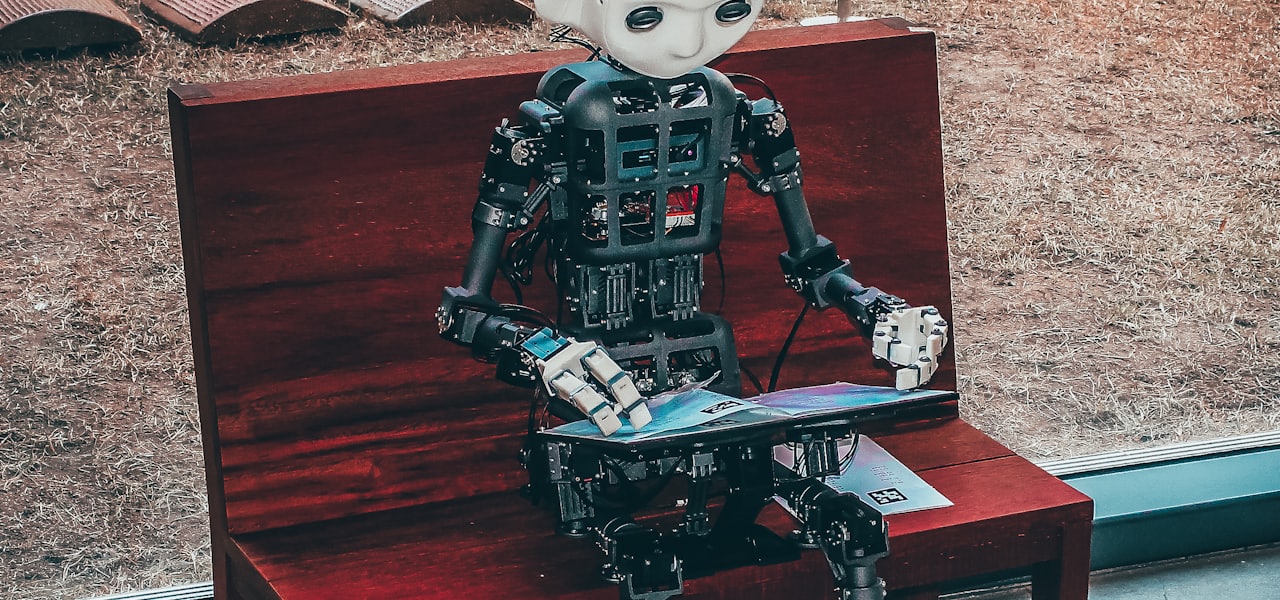
    Robot Monk Xian'er (Chinese: 贤二机器僧) is a humanoid robot based on the cartoon character Xian'er. It was developed by a team of monks, volunteers and AI experts from Beijing Longquan Monastery in Beijing, China. He can follow human instructions to make body movements, read scriptures and play Buddhist music. He can chat and respond to people's emotional and spiritual questions with Buddhist wisdom. As a chatbot, Robot Monk Xian'er is available on certain public platforms including WeChat and Facebook. Over the years, master Xuecheng, the abbot of Beijing Longquan Monastery, replied to thousands of questions on Sina Weibo. These questions and their answers become the data source of the chatbot.

    Read more →
  • Latent semantic mapping

    Latent semantic mapping

    Latent semantic mapping (LSM) is a data-driven framework to model globally meaningful relationships implicit in large volumes of (often textual) data. It is a generalization of latent semantic analysis. In information retrieval, LSA enables retrieval on the basis of conceptual content, instead of merely matching words between queries and documents. LSM was derived from earlier work on latent semantic analysis. There are 3 main characteristics of latent semantic analysis: Discrete entities, usually in the form of words and documents, are mapped onto continuous vectors, the mapping involves a form of global correlation pattern, and dimensionality reduction is an important aspect of the analysis process. These constitute generic properties, and have been identified as potentially useful in a variety of different contexts. This usefulness has encouraged great interest in LSM. The intended product of latent semantic mapping, is a data-driven framework for modeling relationships in large volumes of data. Mac OS X v10.5 and later includes a framework implementing latent semantic mapping.

    Read more →
  • Eager learning

    Eager learning

    In artificial intelligence, eager learning is a learning method in which the system tries to construct a general, input-independent target function during training of the system, as opposed to lazy learning, where generalization beyond the training data is delayed until a query is made to the system. The main advantage gained in employing an eager learning method, such as an artificial neural network, is that the target function will be approximated globally during training, thus requiring much less space than using a lazy learning system. Eager learning systems also deal much better with noise in the training data. Eager learning is an example of offline learning, in which post-training queries to the system have no effect on the system itself, and thus the same query to the system will always produce the same result. The main disadvantage with eager learning is that it is generally unable to provide good local approximations in the target function.

    Read more →
  • Pill reminder

    Pill reminder

    A pill reminder is any device that reminds users to take medications. Traditional pill reminders are pill containers with electric timers attached, which can be preset for certain times of the day to set off an alarm. More sophisticated pill reminders can also detect when they have been opened, and therefore when the user is away during the time they were supposed to take their medication, they will be reminded of it when they return. This reminder can be in the form of a light, which also helps for deaf or hearing-impaired users. == Mobile app == A newer type of pill reminder is a mobile app that reminds the owner to take the medication. Some of these applications might effectively support adherence to taking medications.

    Read more →
  • Saliency map

    Saliency map

    In computer vision, a saliency map is an image that highlights either the region on which people's eyes focus first or the most relevant regions for machine learning models. The goal of a saliency map is to reflect the degree of importance of a pixel to the human visual system or an otherwise opaque ML model. For example, in this image, a person first looks at the fort and light clouds, so they should be highlighted on the saliency map. == Application == === Overview === Saliency maps have applications in a variety of different problems. Some general applications: ==== Human eye ==== Image and video compression: The human eye focuses only on a small region of interest in the frame. Therefore, it is not necessary to compress the entire frame with uniform quality. According to the authors, using a salience map reduces the final size of the video with the same visual perception. Image and video quality assessment: The main task for an image or video quality metric is a high correlation with user opinions. Differences in salient regions are given more importance and thus contribute more to the quality score. Image retargeting: It aims at resizing an image by expanding or shrinking the noninformative regions. Therefore, retargeting algorithms rely on the availability of saliency maps that accurately estimate all the salient image details. Object detection and recognition: Instead of applying a computationally complex algorithm to the whole image, we can use it to the most salient regions of an image most likely to contain an object. the primary visual cortex (V1) appears to be responsible for the saliency map, according to the V1 Saliency Hypothesis. ==== Explainable artificial intelligence ==== Saliency maps are a prominent tool in explainable artificial intelligence, providing visual explanations of the decision-making process of machine learning models, particularly deep neural networks. These maps highlight the regions in input data that are most influential on the model's output, effectively indicating where the model is "looking" when making a prediction. In image classification tasks, for example, saliency maps can identify pixels or regions that contribute most to a specific class decision. Developed for convolutional neural networks, saliency mapping techniques range from simply taking the gradient of the class score with respect to the input data to more complex algorithms, such as integrated gradients and class activation mapping. In transformer architecture, attention mechanisms led to analogous saliency maps, such as attention maps, attention rollouts, and class-discriminative attention maps. === Saliency as a segmentation problem === Saliency estimation may be viewed as an instance of image segmentation. In computer vision, image segmentation is the process of partitioning a digital image into multiple segments (sets of pixels, also known as superpixels). The goal of segmentation is to simplify and/or change the representation of an image into something that is more meaningful and easier to analyze. Image segmentation is typically used to locate objects and boundaries (lines, curves, etc.) in images. More precisely, image segmentation is the process of assigning a label to every pixel in an image such that pixels with the same label share certain characteristics. == Algorithms == === Overview === There are three forms of classic saliency estimation algorithms implemented in OpenCV: Static saliency: Relies on image features and statistics to localize the regions of interest of an image. Motion saliency: Relies on motion in a video, detected by optical flow. Objects that move are considered salient. Objectness: Objectness reflects how likely an image window covers an object. These algorithms generate a set of bounding boxes of where an object may lie in an image. In addition to classic approaches, neural-network-based are also popular. There are examples of neural networks for motion saliency estimation: TASED-Net: It consists of two building blocks. First, the encoder network extracts low-resolution spatiotemporal features, and then the following prediction network decodes the spatially encoded features while aggregating all the temporal information. STRA-Net: It emphasizes two essential issues. First, spatiotemporal features integrated via appearance and optical flow coupling, and then multi-scale saliency learned via attention mechanism. STAViS: It combines spatiotemporal visual and auditory information. This approach employs a single network that learns to localize sound sources and to fuse the two saliencies to obtain a final saliency map. There's a new static saliency in the literature with name visual distortion sensitivity. It is based on the idea that the true edges, i.e. object contours, are more salient than the other complex textured regions. It detects edges in a different way from the classic edge detection algorithms. It uses a fairly small threshold for the gradient magnitudes to consider the mere presence of the gradients. So, it obtains 4 binary maps for vertical, horizontal and two diagonal directions. The morphological closing and opening are applied to the binary images to close the small gaps. To clear the blob-like shapes, it utilizes the distance transform. After all, the connected pixel groups are individual edges (or contours). A threshold of size of connected pixel set is used to determine whether an image block contains a perceivable edge (salient region) or not. === Example implementation === First, we should calculate the distance of each pixel to the rest of pixels in the same frame: S A L S ( I k ) = ∑ i = 1 N | I k − I i | {\displaystyle \mathrm {SALS} (I_{k})=\sum _{i=1}^{N}|I_{k}-I_{i}|} I i {\displaystyle I_{i}} is the value of pixel i {\displaystyle i} , in the range of [0,255]. The following equation is the expanded form of this equation. SALS(Ik) = |Ik - I1| + |Ik - I2| + ... + |Ik - IN| Where N is the total number of pixels in the current frame. Then we can further restructure our formula. We put the value that has same I together. SALS(Ik) = Σ Fn × |Ik - In| Where Fn is the frequency of In. And the value of n belongs to [0,255]. The frequencies is expressed in the form of histogram, and the computational time of histogram is ⁠ O ( N ) {\displaystyle O(N)} ⁠ time complexity. ==== Time complexity ==== This saliency map algorithm has ⁠ O ( N ) {\displaystyle O(N)} ⁠ time complexity. Since the computational time of histogram is ⁠ O ( N ) {\displaystyle O(N)} ⁠ time complexity which N is the number of pixel's number of a frame. Besides, the minus part and multiply part of this equation need 256 times operation. Consequently, the time complexity of this algorithm is ⁠ O ( N + 256 ) {\displaystyle O(N+256)} ⁠ which equals to ⁠ O ( N ) {\displaystyle O(N)} ⁠. ==== Pseudocode ==== All of the following code is pseudo MATLAB code. First, read data from video sequences. After we read data, we do superpixel process to each frame. Spnum1 and Spnum2 represent the pixel number of current frame and previous pixel. Then we calculate the color distance of each pixel, this process we call it contract function. After this two process, we will get a saliency map, and then store all of these maps into a new FileFolder. ==== Difference in algorithms ==== The major difference between function one and two is the difference of contract function. If spnum1 and spnum2 both represent the current frame's pixel number, then this contract function is for the first saliency function. If spnum1 is the current frame's pixel number and spnum2 represent the previous frame's pixel number, then this contract function is for second saliency function. If we use the second contract function which using the pixel of the same frame to get center distance to get a saliency map, then we apply this saliency function to each frame and use current frame's saliency map minus previous frame's saliency map to get a new image which is the new saliency result of the third saliency function. == Datasets == The saliency dataset usually contains human eye movements on some image sequences. It is valuable for new saliency algorithm creation or benchmarking the existing one. The most valuable dataset parameters are spatial resolution, size, and eye-tracking equipment. Here is part of the large datasets table from MIT/Tübingen Saliency Benchmark datasets, for example. To collect a saliency dataset, image or video sequences and eye-tracking equipment must be prepared, and observers must be invited. Observers must have normal or corrected to normal vision and must be at the same distance from the screen. At the beginning of each recording session, the eye-tracker recalibrates. To do this, the observer fixates their gaze on the screen center. The session is then started, and saliency data are collected by showing sequences and recording eye gazes. The eye-tracking device is a high-speed camera, capable of recording eye movements at least 250 fr

    Read more →